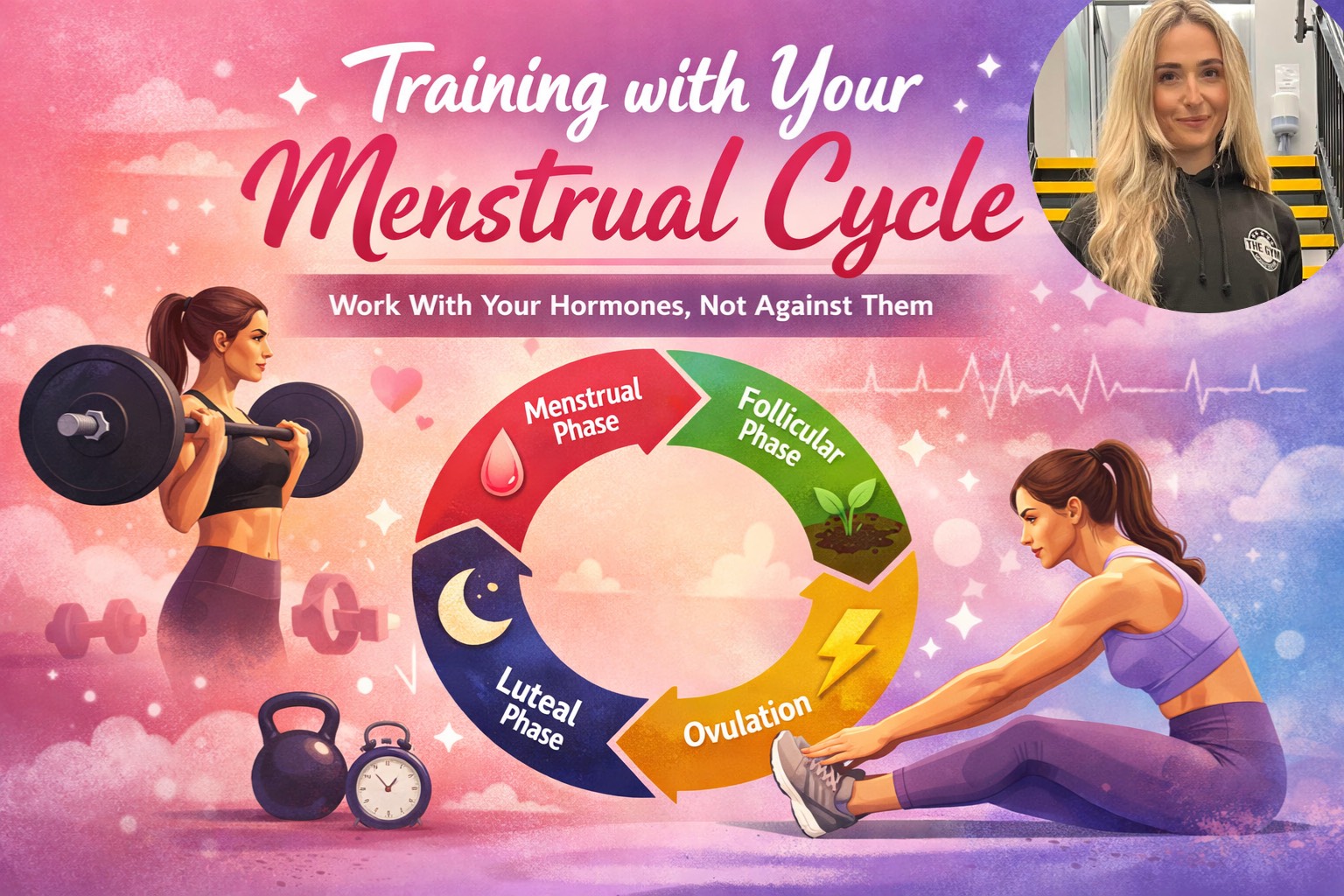
Many women feel frustrated when their energy, strength, and motivation seem to change throughout the month. One week you’re smashing workouts, the next you’re exhausted and unmotivated.
Here’s the truth: your body isn’t inconsistent — it’s cyclical.
Your hormones shift across your menstrual cycle, and those shifts directly affect how you train, recover, and perform.
When you understand these phases, you can adjust your training to get better results with less burnout.
Let’s break it down.
The Four Phases of the Menstrual Cycle & Training
🩸 1. Menstrual Phase (Days 1–5)
What’s happening:
Estrogen and progesterone are at their lowest. Many women experience fatigue, cramps, low motivation, and reduced pain tolerance.
How it affects training:
Lower energy and endurance
Reduced motivation
Recovery may feel slower
Some women feel fine, others feel wiped out (both are normal)
Best training focus:
This is a recovery and reset phase.
Actionable tips:
Choose low-impact workouts: walking, cycling, mobility, yoga
Do light strength with perfect form
Reduce volume (fewer sets/reps)
Prioritise sleep and hydration
Increase iron-rich foods (spinach, lentils, meat if applicable)
Example week:
2–3 light sessions + mobility + rest days
If you feel strong during this phase, you can train normally — always listen to your body first.
🌱 2. Follicular Phase (Days 6–13)
What’s happening:
Estrogen begins to rise. Your brain, muscles, and nervous system become more responsive. Mood and motivation usually improve.
How it affects training:
Better coordination
Faster recovery
Increased strength potential
Higher motivation
Best training focus:
This is your build and progress phase.
Actionable tips:
Increase weights gradually
Try new exercises or skills
Add HIIT or plyometrics
Push for technique improvements
Track PRs and progress
Example week:
3–5 challenging sessions
Strength + conditioning + skill work
This is the best time to “build capacity” for the month.
🔥 3. Ovulation (Around Day 14)
What’s happening:
Estrogen peaks and testosterone rises slightly. Confidence, power, and reaction time often improve.
How it affects training:
Peak strength and speed
High confidence
Best time for performance
⚠️ However: joint laxity may increase slightly, so injury risk can be higher.
Best training focus:
This is your performance phase.
Actionable tips:
Attempt PRs or heavy lifts
Do sprint sessions
Push intensity (short-term)
Warm up thoroughly
Focus on good technique
Example week:
2–4 high-intensity sessions
Strength, power, explosive work
Think: “Quality over quantity.” Push hard, but smart.
🌙 4. Luteal Phase (Days 15–28)
What’s happening:
Progesterone rises, body temperature increases, and your metabolism speeds up slightly. PMS symptoms may appear later in this phase.
How it affects training:
Energy slowly decreases
Higher perceived effort
Slower recovery
Increased cravings
Sleep may be disrupted
Best training focus:
This is your maintain and deload phase.
Actionable tips:
Reduce intensity slightly
Use moderate weights
Increase rest between sets
Focus on steady cardio
Add more stretching and recovery
Eat slightly more protein and complex carbs
Example week:
2–4 moderate sessions
Strength maintenance + steady cardio
In the final 5–7 days, many women benefit from a mini deload.
How to Apply This in Real Life
1. Start Tracking Your Cycle
Use an app, calendar, or notes to track:
Day 1 of period
Energy levels
Training performance
Mood and sleep
After 2–3 months, patterns become clear.
2. Plan Your Training Month
Instead of random workouts, structure your month:
Example structure:
Phase
Focus
Menstrual
Recovery + technique
Follicular
Build strength + skills
Ovulation
Peak performance
Luteal
Maintain + deload
This helps prevent burnout and plateaus.
3. Adjust Volume, Not Just Intensity
You don’t always need to change exercises — often you just change:
Number of sets
Reps
Rest time
Session length
Example:
Follicular: 4 sets × 6 reps
Luteal: 3 sets × 8 reps
Menstrual: 2 sets × 10 reps (light)
4. Support Training With Nutrition
Hormones and training need fuel.
General tips:
Menstrual: Iron + fluids
Follicular: Balanced carbs + protein
Ovulation: Anti-inflammatory foods
Luteal: Slightly higher calories, complex carbs, magnesium-rich foods
Avoid severe dieting — it disrupts hormones.
5. Prioritise Recovery
Recovery needs change across the cycle.
During luteal and menstrual phases:
Sleep 7–9 hours
Stretch daily
Reduce caffeine late in the day
Use active recovery
Progress happens when you recover.
Common Myths
❌ “I’m weak during my period, so I’m unfit.”
→ No. Hormones temporarily affect performance.
❌ “I must train the same every week.”
→ Consistency doesn’t mean sameness.
❌ “Rest means losing progress.”
→ Strategic rest improves progress.
Important Reminder: Individual Differences Matter
This framework is a general guide, not a rulebook.
Your experience may be affected by:
Birth control
PCOS or hormonal conditions
Stress levels
Sleep quality
Work schedule
Nutrition
Training history
Some women feel strongest during menstruation. Others struggle in follicular. Both are normal.
The best program is one that adapts to your body.
Final Thoughts
Training with your menstrual cycle isn’t about doing less — it’s about doing things at the right time.
When you align your workouts with your hormones, you can:
✅ Improve performance
✅ Reduce injury risk
✅ Avoid burnout
✅ Feel more confident in your body
✅ Build sustainable results
Your body is intelligent. Learn its rhythm. Work with it — not against it.
Author – Natalia Lopes